
If you’ve spent any time around other green industry leaders, you’ve probably heard it (or said it) yourself: “We should start a podcast.”
And if you're a partner/supplier to the industry...yes. You probably should.
But here’s the hard truth...Most podcasts don’t fail because the host isn’t smart or the guests aren’t interesting. They fail because they skip strategy. They hit record before they ever define what the show is, who it’s for, and why it deserves to exist.
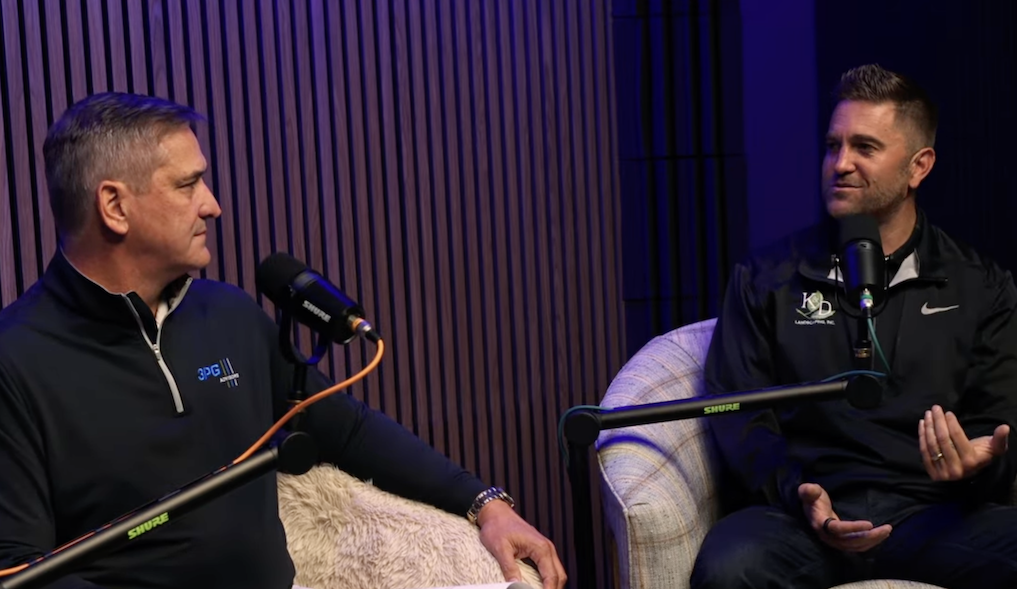
In our recent episode, Scot Leonard (our Multimedia Producer here at Landscape Leadership®) and I broke the green industry podcasting process down into three pillars: Strategy, Production, and Promotion.
The full episode is below, but we’re turning each pillar into a standalone article so you can apply it to your own show.
This first article is about strategy, because it's the foundation that everything else sits on.
Before we get into the “how,” let’s set expectations the right way.
- A great podcast isn’t “content.” It’s positioning.
- A podcast is not just something you publish.
It's your brand’s voice, on display, week after week. It’s the way prospects “meet you” before they ever talk to you. It’s a credibility engine, a trust builder, and, when done intentionally, a growth lever.
But it only becomes those things when it’s built on clarity.
That’s why Scot always starts with the same question when he works with a brand: "Why did you start this company in the first place?"
Sit on that question before you meander into the podcasting adventure.

Because businesses, especially in B2B, often begin with a conviction:
“There’s a better way to do this.”
“Customers are being underserved.”
“The industry is stuck in its old habits.”
“I saw a pain point, and I knew I could solve it.”
When you can identify that original reason, you’re not just creating content anymore. You’re building a show that reflects your unique point of view.
And “unique point of view” (POV) might be the most important phrase in podcast strategy.
Your Unique Point of View: The Antidote to “Podcast Noise”
There are more podcasts than ever, which means there’s also more mediocrity than ever. These shows are technically fine, but instantly forgettable.
Scot put it bluntly on the episode: with so much noise online, you have to have a differentiating point of view, or you’re just adding to the pile.
That doesn’t mean you need to be controversial for the sake of being edgy. It means you need to be clear about what you believe and be willing to say it consistently.
A simple way to think about it:
Most podcasts sound like summaries.
The best podcasts sound like convictions.
That’s why we’ve been building our podcast network around exclusive categories, so each show can own a lane, not compete with everyone else saying the same thing.
For example, one of our network shows is The Deal Factory, powered by 3PG Advisors.
There’s plenty of content out there about mergers and acquisitions in the green industry. But Jeff and his team have a distinct perspective because of where they sit in the ecosystem, between contractors and private equity.
That middle-ground position shapes their insights, their questions, and the way they interpret what’s happening in the market.
That’s strategy. Not “let’s start a podcast.” It’s “this is the lane we will own.”
The 3 Core Strategy Decisions (Before You Ever Worry About Gear)
Once your point of view is clear, strategy becomes three big decisions:
Who are we talking to?
What are we going to be known for?
What format will bring that to life best?
Let’s unpack those.
1) Who is the show for?
A podcast can’t be “for everyone.” If you try that, it ends up being for no one.
Your show should be for a specific audience with a specific need. In green industry terms, that could be:
- Owners scaling from $3M to $10M
- GMs building leadership layers
- Manufacturers trying to reach contractors
- Software companies aiming to reach decision makers
- Industry partners building authority in a niche category
You don’t have to nail the perfect audience on day one. But you do need to choose a primary one, because it impacts your topics, guests, and tone.
2) What will the show be known for?
This is where your POV becomes real-world.
If your company has a strong belief about the industry, then your podcast should become the place where people go to hear that belief expressed with clarity.
Scot said it well: Just like a company needs differentiation to stand out, a podcast needs differentiation to break through.

Practical questions we walk through with clients:
What do you believe that most of the industry disagrees with?
What do you believe that the industry agrees with, but no one says out loud?
What do your best customers thank you for repeatedly?
What “problem” are you trying to solve with your point of view?
The goal isn’t to create a show that’s “interesting.” The goal is to create a show that becomes useful and memorable.
3) What format fits your personality and your goals?
This is one of the most overlooked strategy decisions, because podcasters often default to: “Let’s interview people.”
Interviews can be great. But the best format is the one you can sustain and the one that best serves your goals.
Scot breaks format down into three common lanes:
- Solo (monologue): You teaching, sharing insights, and building thought leadership.
- Interview-based: You hosting conversations with guests (great for relationship building and authority).
- Co-hosted commentary: Two consistent voices discussing topics (high chemistry, high repeat listening).
There are pros and cons to each, and part of the strategy is choosing the one that matches who you are.
Because here’s the truth: podcasts that perform aren’t just great because the topics are good. They perform because the personality is real.
Scot described it like this. Content matters, but content without personality and packaging is just noise.
And we’ve seen that firsthand. Two shows can cover the same topic. One is forgettable, the other becomes appointment listening. It's because one has a clear voice and a consistent style.
Tone Matters: You’re Building a “Show,” Not a Meeting
A podcast isn’t a Zoom call you happen to publish.
Tone is a strategy decision because it tells the audience what to expect:
- Serious and analytical
- Warm and conversational
- Humorous and “real”
- Fast-paced and punchy
- Calm and mentoring
And your tone needs to match your brand.
Scot’s approach is to start by understanding the host:
How do you think?
How do you speak?
How much humor fits your brand?
Are you best at conversation or best at teaching?
This is where so many green industry podcasts accidentally fall into a trap: they try to copy another show’s “vibe” instead of leaning into their own.
You don’t need to be Joe Rogan. You don’t need to be the Kelce brothers on New Heights. But you can learn from them:
Rogan proves the power of long-form conversation and curiosity.
New Heights proves the power of consistent chemistry and familiar banter.
What matters is that your show’s tone feels like you, amplified.
The Strategy Checklist (Use This Before Recording Your First Episode)
If you want a practical takeaway, here’s a strategy checklist you can run in a single meeting:
- Purpose: Why does this show exist?
- Audience: Who is it for (primary listener)?
- Point of View: What do we believe that makes us different?
- Promise: What will listeners consistently gain from tuning in?
- Format: Solo, interview, or co-hosted commentary?
- Tone: What should it feel like to listen/watch?
- Cadence: How often can we publish consistently?
- Episode structure: What segments or flow will repeat each episode?
- Pre-production process: How will topics be chosen and outlined?
If you can answer those questions, you’re ahead of most podcasts before you ever record a second of audio.
Up Next: Podcast Production Advice
In the next article in this series, we’ll move into Production (how to make your show look and sound top-tier without getting lost in “gear obsession”), and what separates a professional production from something that feels homemade.

And after that, we’ll cover Promotion (how to turn one episode into a content engine that drives awareness and demand over time).
For now, if you’re considering a podcast in the green industry, we invite you to learn more about our podcast production and promotion services, see examples of our work, and see our open slots in the Landscape Leadership® Podcast Network.